How eyes affect our perception of a humanoid robot’s mind
How eyes affect our perception of a humanoid robot's mind
by Tampere University
edited by Gaby Clark, reviewed by Robert Egan
Editors' notes
The GIST
Add as preferred source
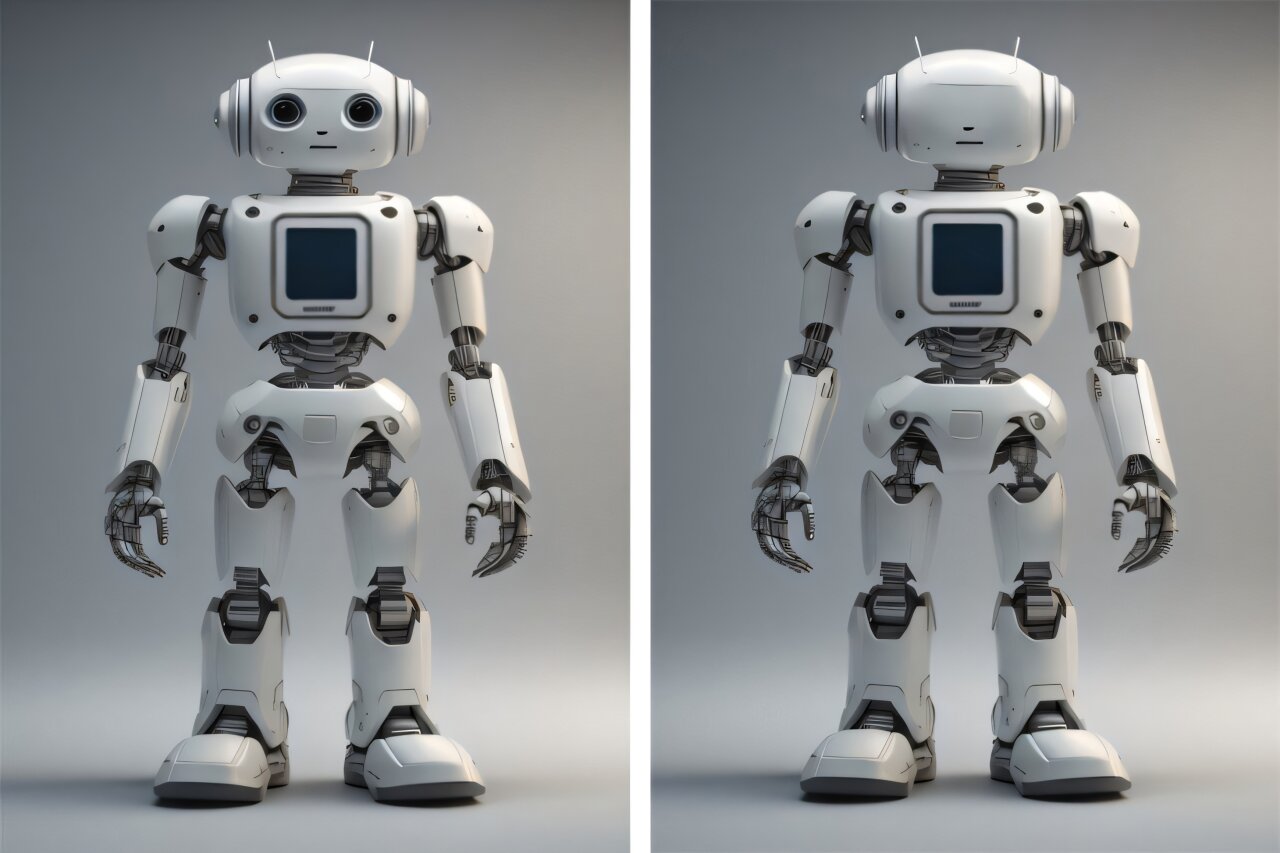
Researchers used artificial intelligence to generate images of a humanoid robot, both with and without eyes. Credit: AI generated images: Dennis Küster
Eyes are said to be the mirror of the soul. Eyes and gaze direction guide attention, evoke emotions and activate the brain's social perception mechanisms. Researchers at Tampere University and the University of Bremen conducted a study examining how people perceive the minds of humanoid robots. Mind perception refers to the way humans detect and infer that other people, beings or even objects possess consciousness, emotions and cognitive states.
Mind perception is often divided into agency and experience. Agency refers to abilities such as thinking, self-control and evaluating the consequences of actions. Experience, on the other hand, encompasses the capacity to feel emotions. Humans have a strong tendency to attribute such mental qualities to various phenomena and objects, such as food-delivery robots. However, not all humanoid robots on the market have facial features that can be interpreted as eyes.
The experiments conducted by the researchers showed that robots were perceived as having greater agency and experience when they had eyes. The research is published in the journal Consciousness and Cognition.
Results benefit humanoid robot designers
In the study, the researchers first used AI to generate a large set of realistic-looking humanoid robots. Each robot was modified into two versions: one with eyes and one without. Images of these robots were then presented in two separate experiments to a large group of participants.
Regardless of whether the robots appeared childlike or adult, and whether the eyes were displayed on a facial screen or embedded directly into the facial structure, the robots with eyes were consistently judged to possess greater agency and experience.
Professor Jari Hietanen from Tampere University, who led the study, highlights that the effect of eyes was also evident in an experiment that did not rely on conscious self-assessments. This finding suggests that the presence of eyes increased mind perception at an early, preconscious level of information processing.
"This study demonstrates that eyes are far more than an aesthetic detail—they can shape how people perceive the social and moral status of robots. This is significant, because the perception of a mind influences empathy, willingness to cooperate and even how people treat technology ethically. These findings have direct implications for the design of humanoid robots," notes Professor Hietanen.